


Victory Courses and Beyond
...
Ben Berkompas
Project Creator
Overview
Covenant Eyes helps people break free from pornography through relationship-focused accountability. Our paid service monitors, evaluates and relays activity from their devices to a person of their choosing, encouraging them toward transparency and honesty.
This is an ultra-private, ultra-sensitive space! The stakes can be enormously high with marriages in disarray, trust hanging by a thread, and devastated people pulling away from those they love, retreating further into secrecy and isolation.
Context
For 25 years, we’ve been known for our accountability service, which we offer as a paid subscription through our Victory app.
We publish a lot of supplemental material to teach people about accountability and help them get the most out of our service, mostly in the form of eBooks and blog posts.
At this point we had never offered educational content within the app itself.
Short courses
In 2022, we began offering short courses in Victory as a way to advance our mission of “helping the world to live porn-free”. These courses were available for free to anyone who created an account, so even people who weren’t ready or able to subscribe to our paid accountability service could begin their journey to victory.
Since then, courses never contributed noticeably to revenue, conversion, or retention. That hadn’t been our goal.
Time to “Grow”
Leaders in Product and Marketing had mixed feelings about whether courses could (or should) become a revenue driver. However, when we began thinking about expanding beyond courses there was renewed interest in the possibility.
Keep in mind, we had been accustomed to charging for our core subscription service and that had been the case for 2 decades. The idea of producing independently valuable offers — and charging money for them — was more of a paradigm shift for us than you might expect.
I had recently helped overhaul the main navigation labels in Victory where we renamed “Learning” to “Grow”, signalling our intent to go beyond courses and offer a fuller set of recovery-focused features.
“Grow” was more of an aspirational move. Nobody had a “master plan” for where we were going or how to get there. Our Recovery Education team had the clearest vision of anyone, but they needed help to get others on board.
I joined them to figure out how to achieve the long-term outcomes they were envisioning.
Timeline
I was directly involved in the project for 5 months, between May and September, 2025. After that I shifted gears and offered “backstage” long-term support.
Team
Ben
Product Designer
Mari
Product Designer
Sam
Director of Recovery Education
Lisa
Recovery Education Content Strategist
Meliza
UX Manager
Collin
Product Manager
Andrew
Software Developer
Jeremy
Software Developer
Bill
Data Scientist
My role
Project management & facilitation: Help stakeholders see the breadth of opportunities — things we could do — while making clear decisions about what we should do. Facilitate alignment between stakeholders through workshops, clear communication, and thorough documentation of our work.
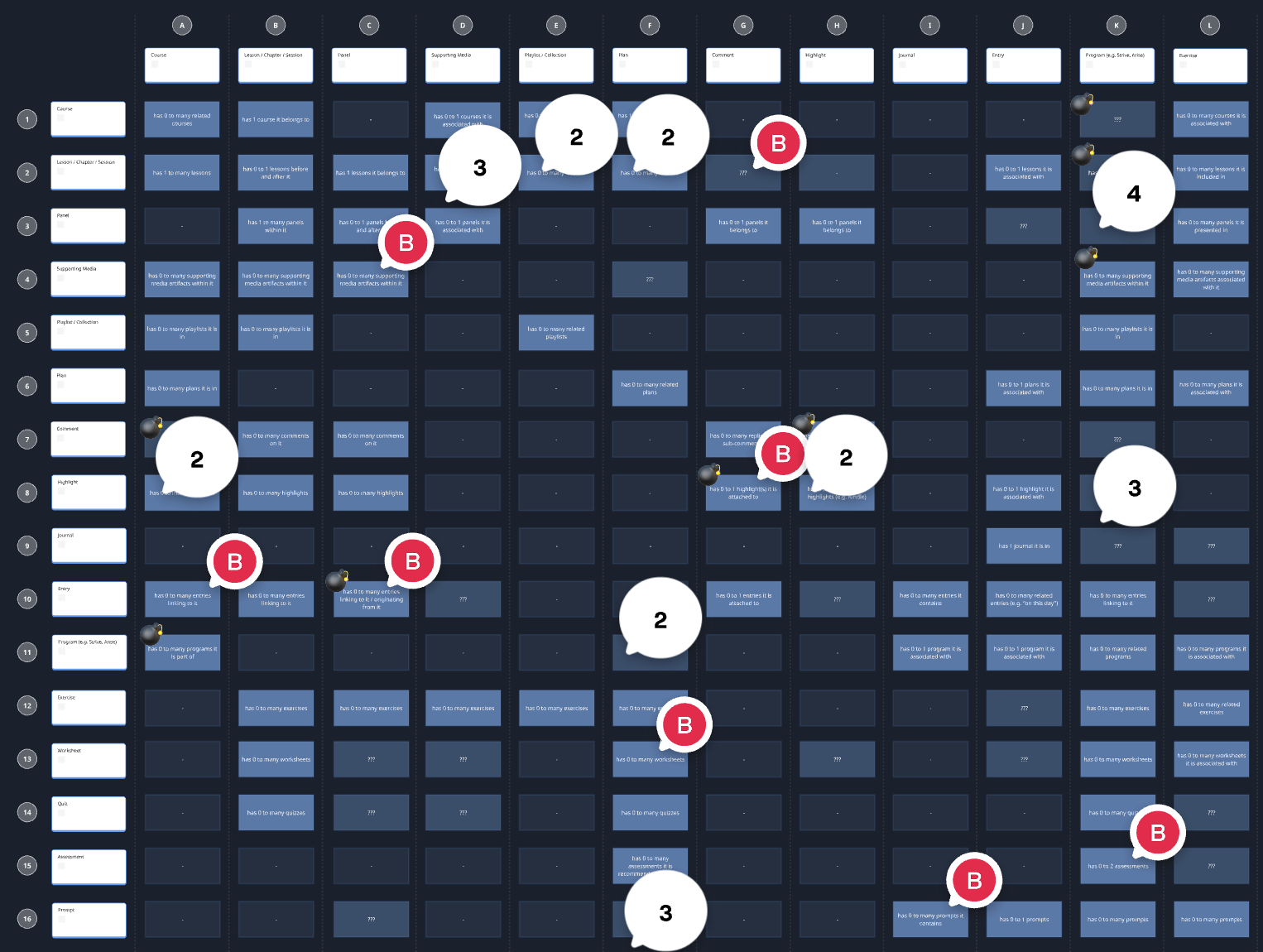
Information architecture: Design the invisible structure behind our service so users can find, understand, and accomplish what matters to them. Provide clear conceptual models that guide product decisions, help teams align, reduce risk, and help us deliver more intuitive experiences.
Interaction design & prototyping: Translate ideas from abstract concepts into concrete design outputs that demonstrate the logical implications of our decisions. Use AI to generate “high-interaction-fidelity” prototypes that feel realistic but not “final”, helping us to maintain a more experimental mindset.
Challenge
1. Help others see the opportunity
The first challenge was to help people see the latent opportunity in this part of our service.
As I’ve already mentioned, courses were not perceived as a revenue driver. Consequently, we invested in the experience very sparingly. We continued to add new courses, reaching about 40 at the time of this writing. In some ways, that put an extra strain on the navigation, which had been designed when we had far fewer courses.
2. Clarify our vision for the future
Secondly, we had just declared this to be an “up and coming” area of our service by giving it a new, more expensive label in the main navigation. This is ironic given my first point about it’s relatively low priority.
So, the second challenge was to paint a more vivid picture of what the future would look like. This would obviously help us convince people to invest in it!
3. Remain grounded in the present
Right on the heels of that was our third challenge: reaching into the future while remaining grounded in the present. We couldn’t just catch people on a grandiose vision of “someday”, we would need to help them see the practical steps required to get there.
Our process for prioritizing and selecting work tends to favor smaller, self contained efforts. There are many exceptions, of course, but we knew it would be important to boil down our proposals into something very practical, yet compelling enough to seem worthwhile and valuable.
I have a principle: “design in layers, implement in slices.“
Technical Challenges
One of the biggest challenges was creating a reliable voice recognition system that could work effectively in noisy environments and understand diverse speech patterns, including users with speech impediments. We solved this by implementing a custom machine learning model trained on a diverse dataset of voices and ambient conditions.
Project Gallery



Testimonial
Maria Rodriguez, Beta TesterThis system has given me back my independence at home. The voice controls are so natural, and the haptic feedback helps me confirm every action without needing to see anything.
The project continues to evolve with regular updates based on user feedback, with a focus on expanding support for multiple languages and additional accessibility features.