
Separating Intent from Commitment in Sales Systems
A system design case study about separating recognition, qualification, and commitment — so sales tools support real customer relationships, not just transactions.
Situation
By 2017, QuoteCenter had become a core part of The Home Depot’s strategy to grow share with professional contractors.
QuoteCenter 2.0 (QC2) was a platform-wide update intended to streamline quoting while more deeply integrating with the order management and POS systems used daily in stores.
Problem
Pro Sales Associates were evaluated on close rate, quotas, and follow-ups, often tied to specific customers they were responsible for. As a result, many were reluctant to create an order before they had confidence in a customer’s intent. Doing so could inflate their pipeline and make personal close rates appear artificially low.
In QC1, QuoteCenter implicitly supported this behavior through workarounds like “ghost bids,” which allowed associates to explore pricing without formally committing to an order.
QC2 removed those loopholes. The team now had to decide when the system should require commitment to drive a sale, and when it should allow exploration so associates could serve customers without prematurely inflating their order count.
Team
I modeled associate workflows, conducted field interviews, synthesized findings, and made system-level design recommendations.
In doing so, I helped the team recognize that customer intent is inferred over time — not known upfront — and redesign the system to support progressive commitment rather than forcing premature decisions.
Ben
Design Lead
Leo
UX Manager
Mike
Product Manager
I interviewed Pro Sales Associates from multiple U.S. stores: Yvette (OR), Raul (CA), Christina (CA), Michelle (WA), Paul (TX), Lucas (MN), and Carrie (TX).
Constraints
- System constraints: The Volume Pricing Program (VPP) required an order ID for every bid, forcing associates to create an order before knowing whether discounted pricing would lead to a purchase.
- Behavioral patterns: Associates had learned to delay commitment in QC1 — using it to determine pricing without creating official orders — and resisted workflows that removed that flexibility.
- Mental models: QuoteCenter was not the default starting point for many associates, who treated it as a secondary tool used when a customer was not yet ready to buy.
If I have a customer who knows exactly what he wants, I will just go into eSVS to punch SKUs in. Otherwise I’ll go to HD.com or QC to look stuff up.Lucas, Pro Sales Associate (Store 2832 - Albert Lea, MN)
Objective
Design QC2 to support progressive customer commitment, balancing business requirements for customer data with how associates actually infer purchase intent.
Diagnosis
We were implicitly designing for three distinct moments:
- Recognition — knowing who the customer is
- Qualification — determining whether they intend to purchase
- Commitment — formally creating an order in the system
QC2 collapsed these into a single step, forcing commitment before associates could qualify customer intent. As a result, the system was misaligned with how they actually worked — and was often bypassed in real sales interactions.
You’ve got to identify them, then qualify them, then put their name in the system and do your follow-up. ‘Identify customer’ and ‘qualify customer’ would come first. ‘Create new’ and ‘Find existing’ branch from there. Then you go to salesmanship.Raul, Pro Sales Associate (Store 1059 - El Centro, CA)
Approach
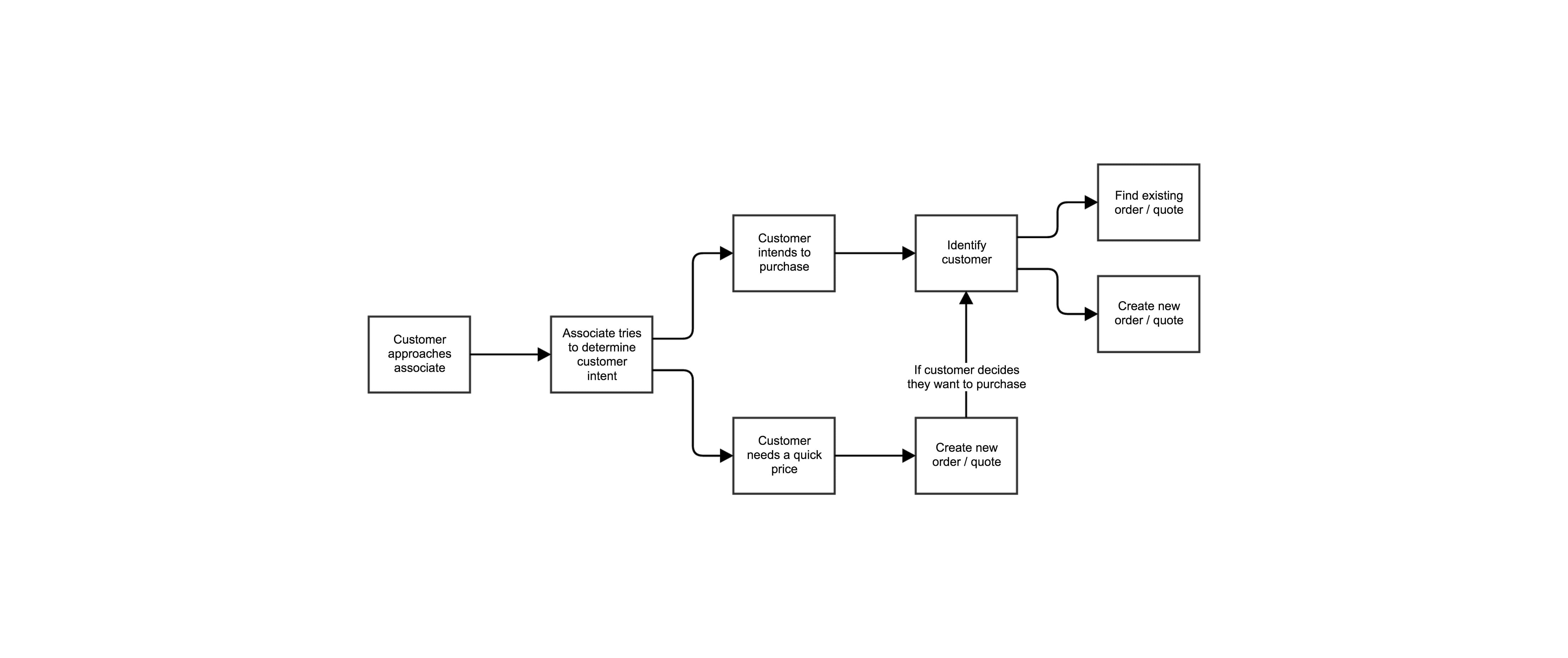
I began by modeling the associate–customer workflow as it was currently designed.
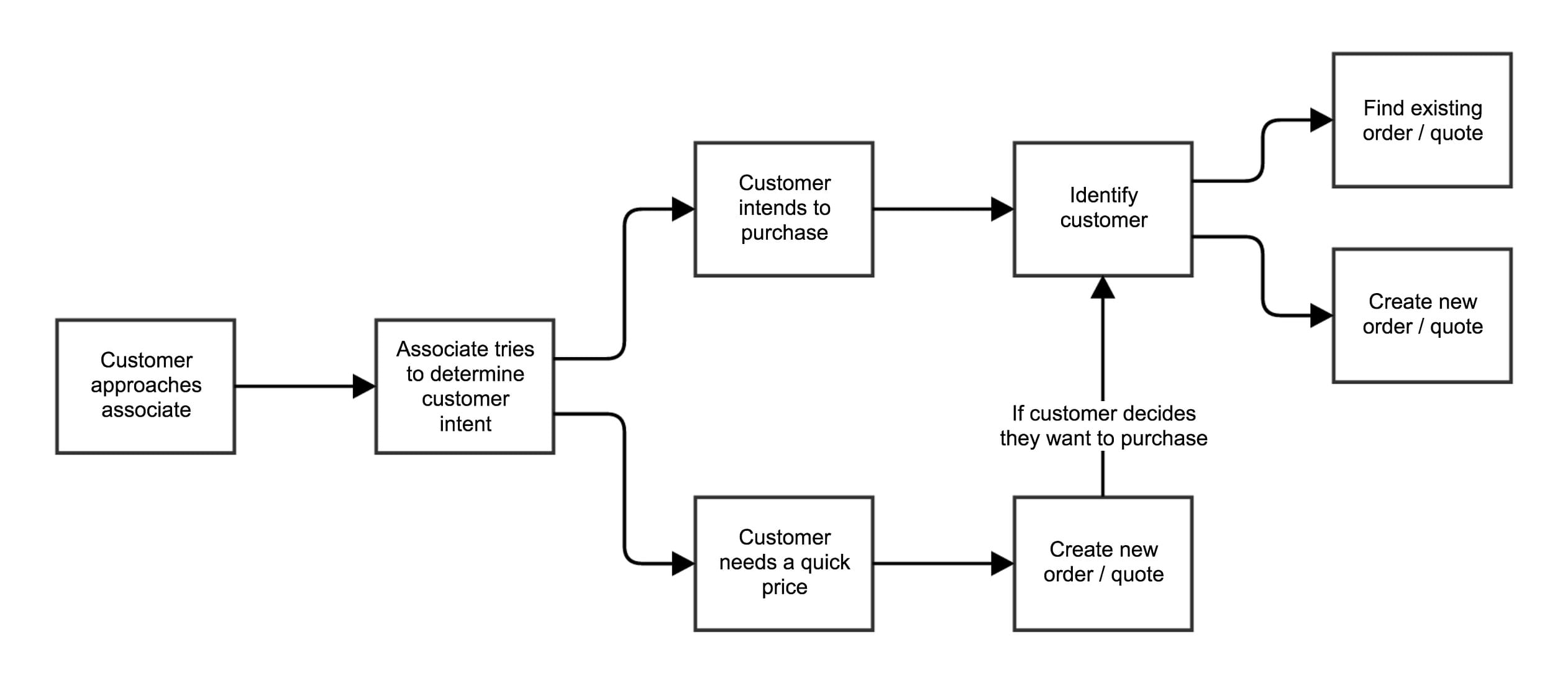
We were making some big assumptions about how associates actually worked with customers
I then interviewed Pro Sales Associates across multiple stores to validate and challenge that model.
Finally, I synthesized the findings into a small set of system-level rules.
Solution
The following rules emerged from the interviews and guided all subsequent design decisions. Together, they separated recognition, qualification, and commitment, allowing the system to reflect how associates actually operated.
1. Allow exploration without commitment
Associates must be able to look up products and pricing without committing a customer to the system.
2. Gate irreversible actions on explicit commitment
Actions that create downstream consequences — such as placing an order or generating an official quote — require an attached customer.
3. Make commitment visible but optional until required
The option to attach a customer should be obvious and easily accessible, without blocking early-stage workflows.
4. Surface context after commitment
Once a customer is attached, relevant context (identity, history, account status) should be immediately available to support follow-up and continuity.
Outcome
This work helped the QC2 team avoid enforcing a workflow that would likely have been resisted regardless of UI quality.

It also established a shared mental model for intent-based workflow design, shifting focus from quoting and ordering to supporting how associates actually manage their customer relationships.
After all, sales is about service — not just the transaction.
Sometimes you don’t want to just take their money… I recently helped a lady who came in with drawings for a roofing project. She didn’t fully know what she wanted, and I helped her build a materials list. When she said, ‘Let me just pay for this and we’ll go,’ I stopped her and said, ‘Time out, the person who is going to install this will need to review it. You’re out in the dessert. We don’t want to make a mistake on the delivery.’Raul, Pro Sales Associate (Store 1059 - El Centro, CA)